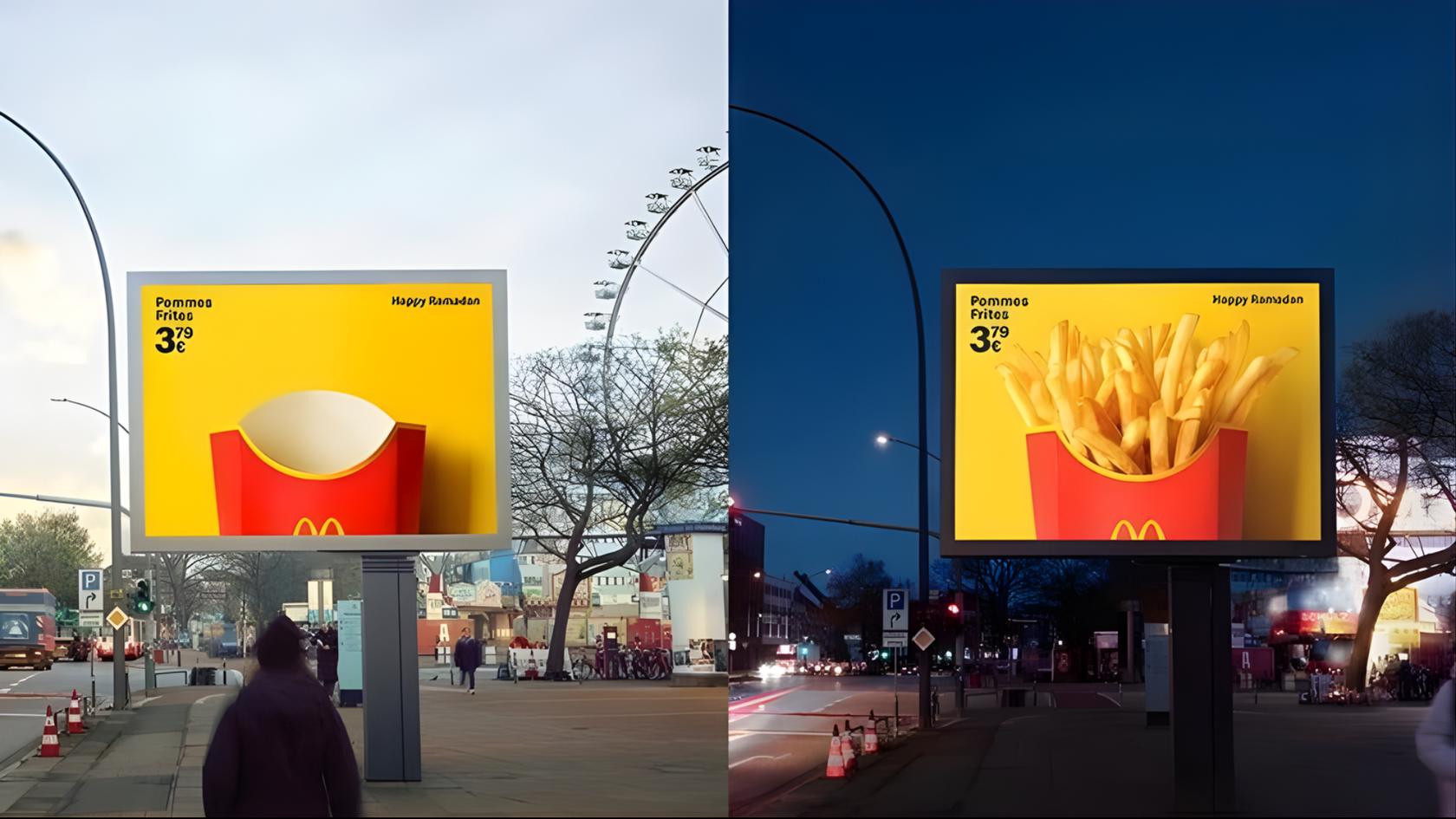
Among the marketing campaigns of February and March, one in particular caught our attention and deserves a closer look: McDonald’s in Germany has launched a project that goes beyond the usual seasonal ad, making cultural sensitivity its defining feature.
During the month of Ramadan — a period when Muslims fast daily from dawn to sunset — McDonald’s renewed its outdoor presence with a Digital Out‑of‑Home (DOOH) campaign that leverages technology to align perfectly with the solar cycle.
The concept is simple:
- During daylight hours, when those observing the fast cannot eat, digital screens show only empty packaging — the fries container, the burger box — with no appetizing images of food.
- At sunset, at the exact moment of Iftar (the breaking of the fast), the same packaging “fills up” in real time, revealing fries, burgers, and the brand’s iconic dishes.
There are no flashy slogans: the timing itself becomes the message, turning the moment of sunset into a creative element.
Developed by the German agency Scholz & Friends, the campaign relies on dynamic programming of DOOH displays, synchronized with solar data or daily calculated time slots to match precisely when the fast ends.
This approach demonstrates how advanced out‑of‑home advertising has become: not only capable of responding to weather or traffic data, but also of interpreting social rhythms in real time.
From a strategic perspective, it’s an example of cultural marketing guided by listening. The campaign does not alter the menu or introduce specific products; what sets it apart is how the brand chooses to be seen, opting to show the product only at the right moment instead of promoting it continuously.
The product’s visibility is delayed rather than emphasized. This choice speaks to a deep psychological dimension — that of anticipation — turning the brand’s gesture into a form of respect rather than aggressive selling.

Practical Takeaways
McDonald’s campaign offers valuable insights for advertising and communication professionals:
- Context before content: knowing when to speak can be more important than what is said.
- Technology serving culture: the use of real-time data opens new possibilities for truly dynamic advertising.
- Empathy as a strategic lever: it’s not just about respect; it can create recognition and memorability more effectively than a direct promotional message.
In a media ecosystem saturated with stimuli, McDonald’s chose to run a campaign that waits for the right moment, rather than filling every minute with images and offers. It’s an example that encourages us to rethink the brand’s role as an active participant in the daily rituals of its consumers.