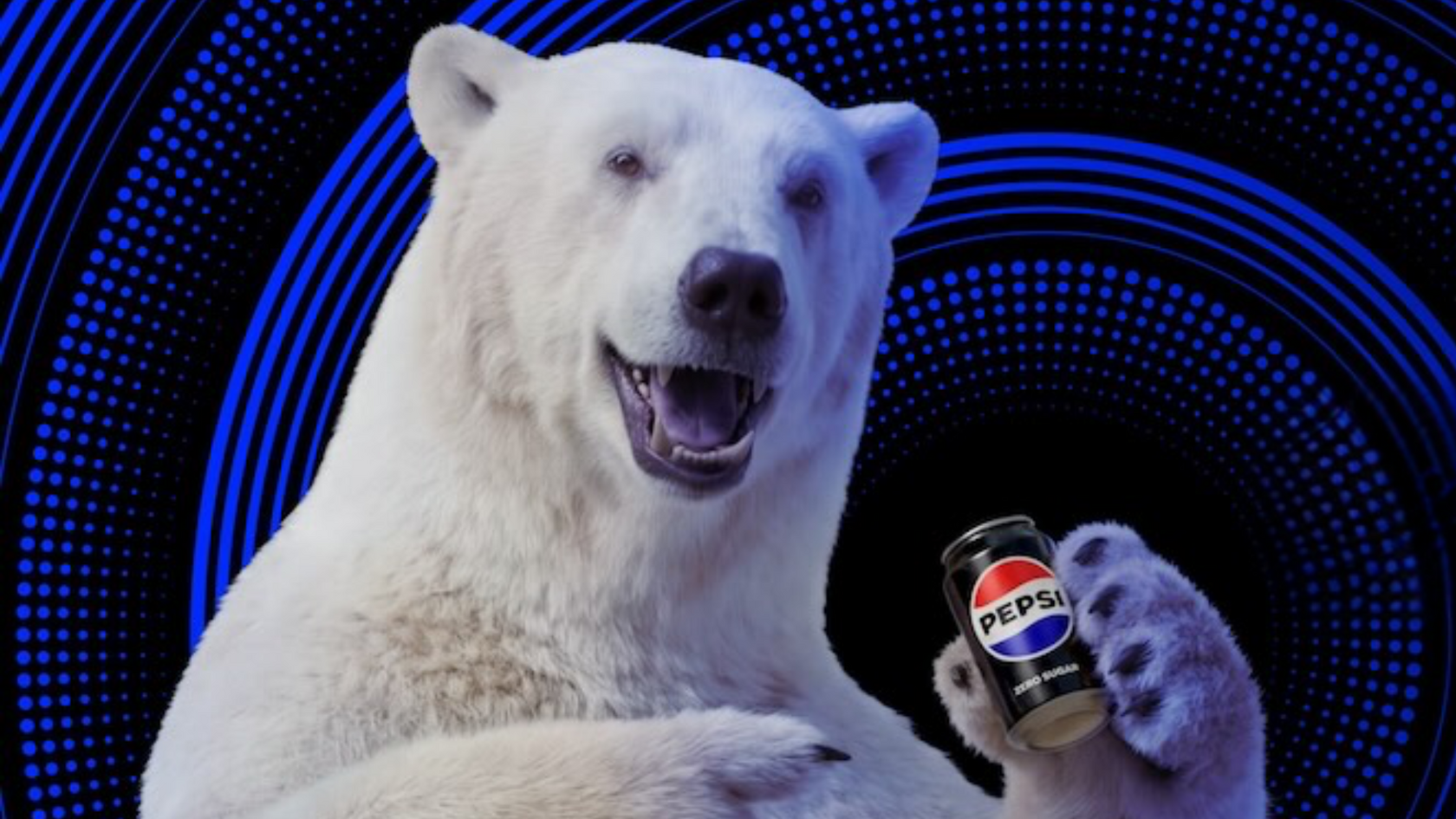
At Super Bowl 2026, Pepsi plays the most powerful card in its history once again: its rivalry with Coca-Cola. It does so with The Choice, a 30-second commercial that reignites one of the longest-running advertising wars in global marketing, cheekily appropriating one of Coca-Cola’s most iconic symbols: the polar bear.
The spot opens with a taste test: a blindfolded polar bear is asked to choose between Pepsi Zero Sugar and Coke Zero Sugar. His answer (Pepsi) throws his entire belief system into crisis. When he discovers what he has chosen, the bear ends up in therapy with a psychoanalyst played by Taika Waititi, who also directs the commercial. Only after “accepting” his choice does the bear return to the real world, where he meets another polar bear who shares the same preference.
In the final scene, the two bears are captured together on a giant screen during a concert, a moment that echoes the scandal surrounding a Coldplay concert—except here, the “traitors” don’t hide.
A borrowed icon (deliberately)
The polar bear becomes the narrative vehicle for a simple yet strategic message: true choice only emerges when prejudice and labels are stripped away.
The move is as bold as it is calculated. Polar bears have appeared in Coca-Cola’s communications since 1922, but they became a global pop icon with the 1993 relaunch by Creative Artists Agency. Pepsi doesn’t ignore this legacy—on the contrary, it openly appropriates it, playing on the audience’s self-awareness and the symbolic power of the reference.
The move is as bold as it is calculated. Polar bears have appeared in Coca-Cola’s communications since 1922, but they became a global pop icon with the 1993 relaunch by Creative Artists Agency. Pepsi doesn’t ignore this legacy—on the contrary, it openly appropriates it, playing on the audience’s self-awareness and the symbolic power of the reference.
“It’s the story of a polar bear who loves cola and has great taste.”
—Gustavo Reyna, VP Marketing, Pepsi
—Gustavo Reyna, VP Marketing, Pepsi
Taste as the battlefield
The soundtrack, I Want to Break Free by Queen, reinforces the theme of liberation from conventions. This isn’t the first time PepsiCo has used the song: five years ago it already appeared in the Doritos Flat Matthew commercial.
The Choice specifically revives a historic theme: taste is the most persuasive argument Pepsi can make. It’s no coincidence that the spot explicitly recalls the Pepsi Challenge, launched in 1975 and turned into a central weapon during the Cola Wars. That very narrative pushed Coca-Cola toward the infamous misstep of New Coke, one of the most disastrous counteroffensives in marketing history.
Today, sugar-free colas are one of the few growth areas in an otherwise mature category. According to Beverage Digest data (Q3 2025), Coke Zero Sugar still holds a larger share of the total carbonated soft drink market than Pepsi Zero Sugar (4.6% vs. 1.4% by volume). However, Pepsi Zero Sugar is growing much faster: +18.1% in volume compared to +4.8% for its competitor. Additionally, Pepsi Zero Sugar grew by more than 30% through November 9, nearly double the growth of the overall sugar-free beverage segment and almost triple that of Coke Zero Sugar.
The Pepsi Paradox
Reyna explained that the commercial stems from observing a psychological tension often referred to as the Pepsi Paradox: the gap between what people claim to prefer and what they actually choose in a blind taste test.
“Sometimes people think they prefer something different from what they actually prefer. That tension in the decision-making process is a human truth.”
In this sense, The Choice is a strategic statement. With Coca-Cola absent from the Super Bowl since 2020 and now focused on the FIFA World Cup 2026, Pepsi is left with the loudest stage of the year—and uses it to reaffirm its historic role as the challenger.
It’s not the first time (and likely won’t be the last) that Pepsi launches ads and campaigns involving Coca-Cola. Pepsi simply enjoys poking Coca-Cola.
Spot 1996
Another Pepsi Commercial with Snoop Dogg for the 2006 Super Bowl
2006 Commercial: Jackie Chan Uses Coca-Cola as a Stunt Double
Spot 2001
Spot 1995